
|
Allora
Real-time, bi-directional XML-RDB transformation
Java middleware
Allora can generate XML from any database
and write XML element and attribute values into any database. It
is an XML database mapping platform that consists of: (1) design-time
tools for mapping XML to relational data or text; (2) wizard support
for popular application
servers and IDE tools; (3) a
rich set of application programming interfaces to the Allora run-time
engine; (4) a Workflow Manager tool
to organize and execute a set of transformation tasks with associated
XML file manipulation; (5) a set of SOAP interfaces to the Allora
web service engine for building distributed applications; and
(6) a database connector for Funambol
Mobile Application Server.
Allora works with any relational database
that has a JDBC or ODBC connector. Allora has been certified to
work well with over 20 different databases. Allora bi-directionally
transforms XML and data stored in relational databases such as DB2,
Oracle, Microsoft SQL Server, MySQL, Informix, Ingres, IDMS, Datacom,
ANTs, MaxDB, Sybase.
Allora speeds development and deployment of
applications involving XML-RDB/text applications by accurately and transparently
transforming data structures between XML elements/attributes and relational
database structures or text. Once Allora mapping is in place, full bi-directional
XML-RDB access is enabled. Allora XML database transformation gives developers
a simplified, consistent XML interface to relational data.
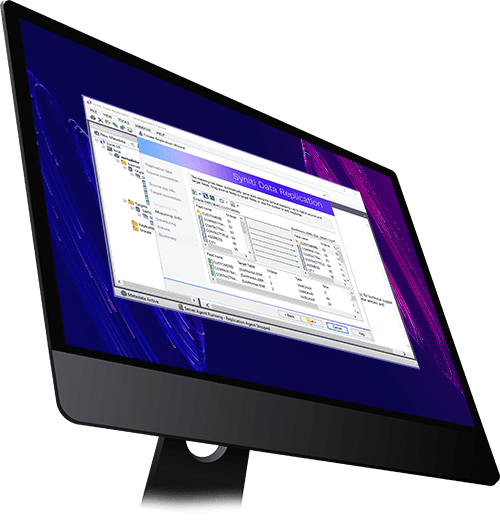
Allora's design-time components for data transformation include a graphical
Mapper application, source code wizards, object interfaces, and sample source code.
The design-time graphical Mapper application lets developers simultaneously see DTDs
or XML schemas and database catalog structures. Also, the Mapper can automatically
create XML schemas from relational databases and vice versa. Using the mapping files
generated by the Mapper, developers can request data specifying XML structures rather
than database structures or SQL. These mapping files are passed to Allora's interfaces
by calling applications.
Allora offers a rich, flexible set of interfaces. Developers
can refer to data by XML element/attribute references, including XPATH, or by RDB catalog
structures. Similarly, they can exercise XML element/subelement methods or specify
record/field SQL commands. The Allora OVLT API optimizes import and export of data within
very large tables and XML documents. This API increases performance by an order of magnitude
while minimizing local and database server resource requirements. Allora manages all SQL
middleware connection processes for efficient and proper database interaction and data integration.
Allora's data binding object interfaces enable developers to
create objects that represent database records. Data binding includes methods to iterate
through records sequentially, yet retaining the XML formatting structures.
For maximum data access flexibility, Allora can also be implemented
as a full-function SOAP-based web service for remote applications. Allora web service supports
two client access modes: a SOAP interface mode and a higher level remote API mode.
Allora is currently certified
to work with ACORD, AgXML, Bioml, CellML, CIDX, CXML, FpML, HL7,
HR-XML, IFX, JusticeXML, LegalXML, MpXML, MISMO, OFX, PIDX, RosettaNet,
UCCnet, VoiceXML, XBRL.

Allora Specifications
Design-Time Tools
· Graphical mapper application
· Source code wizards for WebSphere Studio, Eclipse, Borland
JBuilder, Oracle JDeveloper, Sun Java Studio and SunForte
· Object interfaces
· Sample source code
Application Programming Interfaces
· Mapping
· Databinding
· JMS
· XPATH
Databases Supported *
· DB2 UDB for z/OS, i5/ iSeries, Linux, AIX, Solaris, Windows
· Oracle
· Microsoft SQL Server
· MySQL
· Sybase
· ANTs
· MaxDB
· and more
* See:
Supported Databases for a complete list
System Requirements
· JDBC or ODBC SQL middleware
· JDK v1.3 or later
For web service use
· Tomcat v3.2.2 or later
· JAXP v1.1 or later
· SOAP v2.2 or later
· Xerces v1.3.0 or later
· gnu regexp v1.0.8 or later
· JavaMain v1.1.3 or later
· JavaBeans v1.0.1 or later

View screenshot details
Integration Modules
· IBM
WebSphere Studio
· Eclipse
· Borland
JBuilder
· Oracle
JDeveloper
· Sun Java
Studio
· Altova
XMLSPY

What does ServerProven mean?
¹ IBM ServerProven Legal


IBM ServerProven: is a marketing program.
Products bearing the IBM ServerProven emblem are licensed to use the emblem based upon
the participant’s submission of information concerning one or more enduser customers
that have implemented its product on the indicated IBM hardware or software platform(s)
and engaged in an enablement activity. IBM does not warrant that results obtained in
end-user customer experiences are typical of those encountered by the participant’s
customer, nor that any installation will be free of errors. Potential customers of
this product(s) are responsible for determining whether any particular participant’s
products or services are suitable for their own needs. The participant should be
contacted regarding this software product and such items as installation, support,
education, documentation, maintenance and any other terms and conditions. All
understanding, agreements, or warranties concerning any product must take place
directly between the participant and the customer.
IBM makes no warranties of any kind with respect to the participant’s product.
Specifically, IBM does not warrant the quality of any third-party products, or the
ability of any such third-party products to interoperate with IBM’s products. IBM
expressly disclaims all warranties, expressed or implied, including but not limited
to the implied warranties of merchantability and fitness for a particular purpose.
This disclaimer does not apply in the United Kingdom or elsewhere to the extent
inconsistent with local law.
|  |